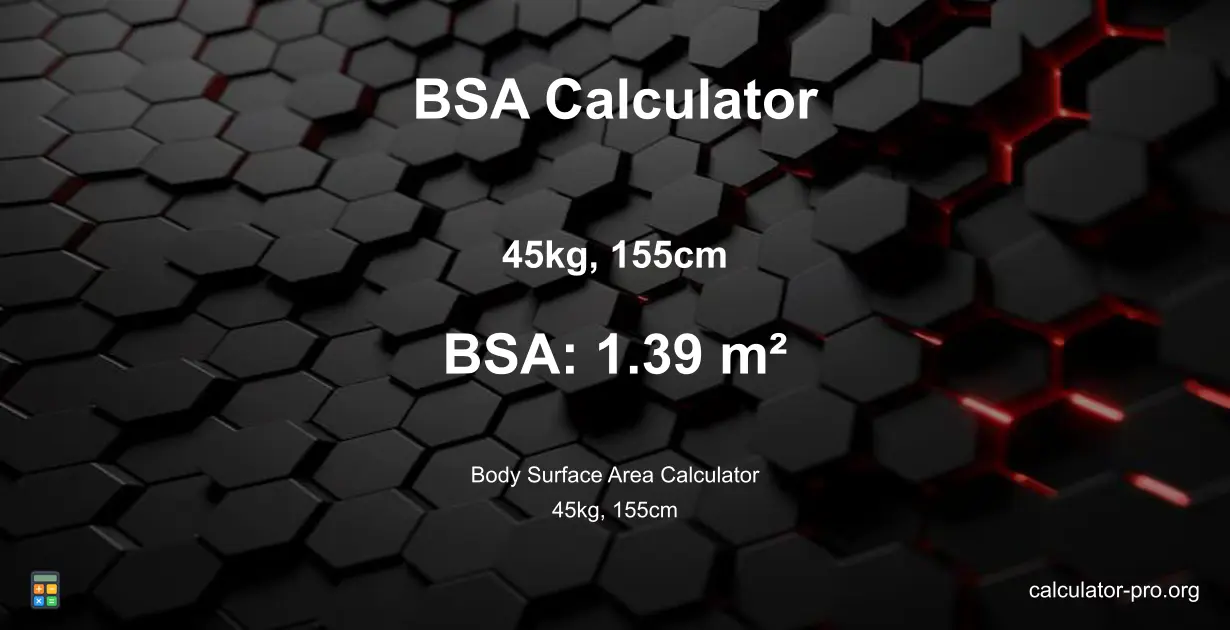
BSA Calculation Results
Mosteller
1.39
m² — most common
DuBois & DuBois
1.4
m² — classic formula
Haycock
1.39
m² — paediatric use
| Weight | 45 kg |
|---|
| Height | 155 cm |
|---|
| BSA (Mosteller) | 1.39 m² |
|---|
| BSA (DuBois) | 1.4 m² |
|---|
| BSA (Haycock) | 1.39 m² |
|---|
Typical BSA ranges
| Population | Average BSA |
|---|
| Newborn | 0.25 m² |
| Child (2 yr) | 0.5 m² |
| Child (10 yr) | 1.14 m² |
| Adult female | 1.6 m² |
| Adult male | 1.9 m² |
Why Body Surface Area Matters in Medicine
Body surface area (BSA) is essential for drug dosing in oncology and paediatrics. Chemotherapy doses are calculated in mg/m² of BSA rather than mg/kg body weight, because tumour drug sensitivity and organ toxicity both scale with body surface. BSA is also used to calculate cardiac index (cardiac output per m² of BSA), to size prosthetic heart valves, and to estimate burns coverage using the Rule of Nines. Average adult BSA is approximately 1.7 m² for women and 1.9 m² for men.
BSA Formulas Compared
| Formula | Best used for |
|---|
| DuBois & DuBois (1916) | General clinical use |
| Mosteller (1987) | Simplest, widely used — √(H × W / 3600) |
| Haycock (1978) | Paediatric patients |
| Gehan & George (1970) | Chemotherapy dosing |
BSA in Clinical Medicine
Body Surface Area (BSA) is used in medicine because many physiological measurements scale better with body surface than with weight alone. Chemotherapy dosing uses BSA because anticancer drugs have a narrow therapeutic window — too little and they're ineffective; too much and they're toxic. The Mosteller formula (most widely used today) calculates BSA as the square root of (height in cm × weight in kg / 3600). The DuBois formula, published in 1916, is BSA = 0.007184 × height^0.725 × weight^0.425. Haycock's formula is preferred for paediatric patients because it performs better at extremes of body size.
A typical adult BSA is 1.7–1.9 m². The average male is approximately 1.9 m² and the average female 1.6 m². Burn patients are assessed using the Rule of Nines, which divides the body into regions each representing 9% of BSA — critical for calculating fluid resuscitation volumes.
BSA Formula Comparison
| Formula | Equation | Best For |
|---|
| Mosteller | sqrt(height(cm) × weight(kg) / 3600) | General adults |
| DuBois | 0.007184 × H^0.725 × W^0.425 | Historical standard |
| Haycock | 0.024265 × H^0.3964 × W^0.5378 | Paediatrics |
| Boyd | 0.0003207 × H^0.3 × W^(0.7285 − 0.0188 log W) | Neonates |
| Gehan-George | 0.0235 × H^0.42246 × W^0.51456 | Widely cited |
See Also
- BSA for 60 kg, 165 cm
- BSA for 65 kg, 168 cm
- BSA for 70 kg, 170 cm
- BSA for 75 kg, 175 cm
- BSA for 80 kg, 178 cm
- BSA for 85 kg, 180 cm
- BSA for 50 kg, 160 cm
- BSA for 55 kg, 162 cm
- BSA for 90 kg, 182 cm
- BSA for 95 kg, 185 cm
- BSA for 100 kg, 188 cm