All Formats for Timestamp 1316779513
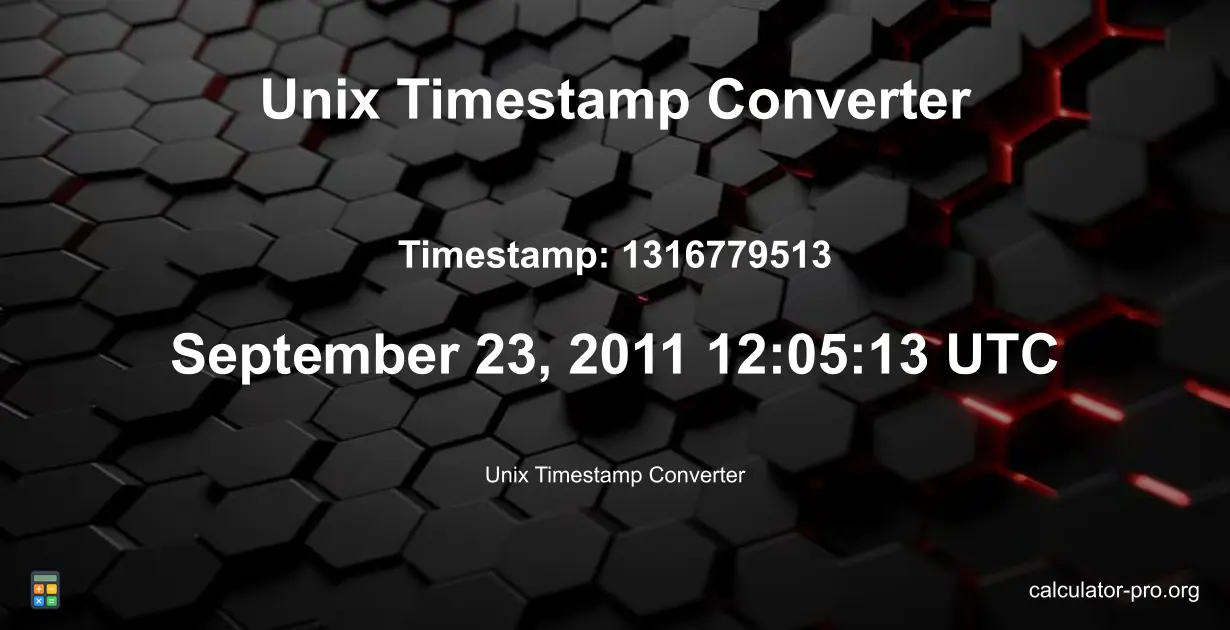
| Unix Timestamp | 1316779513 |
|---|---|
| UTC Date & Time | 2011-09-23 12:05:13 UTC |
| ISO 8601 | 2011-09-23T12:05:13Z |
| RFC 2822 | Fri, 23 Sep 2011 12:05:13 +0000 |
| Day of the Week | Friday |
| ISO Week Number | Week 38 |
What is a Unix Timestamp?
A Unix timestamp (also called Epoch time or POSIX time) is a way to represent a point in time as a single integer � the number of seconds that have elapsed since January 1, 1970, 00:00:00 UTC (the Unix Epoch).
Why was 1970-01-01 chosen?
The Unix operating system was developed in the early 1970s and its creators chose January 1, 1970 as a convenient round-number starting point for their time implementation.
Unix Timestamp Milestones
| Timestamp | Date (UTC) | Event |
|---|---|---|
| 0 | 1970-01-01 00:00:00 | Unix Epoch start |
| 1,000,000,000 | 2001-09-09 01:46:40 | Billennium |
| 1,234,567,890 | 2009-02-13 23:31:30 | Internet celebration |
| 1,500,000,000 | 2017-07-14 02:40:00 | 1.5 billion |
| 2,000,000,000 | 2033-05-18 03:33:20 | Future milestone |
| 2,147,483,647 | 2038-01-19 03:14:07 | Year 2038 problem (32-bit max) |
The Year 2038 Problem
On 32-bit systems, Unix timestamps are stored as a signed 32-bit integer. The maximum value (2,147,483,647) corresponds to January 19, 2038, 03:14:07 UTC. After this point, 32-bit systems will overflow. Most modern systems use 64-bit timestamps, which can represent dates up to ~292 billion years in the future.
Unix Timestamps in Programming
- JavaScript:
Date.now()returns milliseconds since epoch. UseMath.floor(Date.now()/1000)for seconds. - Python:
import time; time.time() - C#:
DateTimeOffset.UtcNow.ToUnixTimeSeconds() - PHP:
time() - SQL (MySQL):
UNIX_TIMESTAMP() - Linux shell:
date +%s